Most Sanford homeowners don't realize they're air conditioning their attic. Gaps and cracks in ductwork silently push 20–30% of your cooled air into unconditioned spaces — and in Central Florida's heat, your system works overtime to compensate for air that never reaches your living areas.
After sealing ductwork in hundreds of Sanford-area homes, our technicians consistently see the same pattern: homeowners assume their aging AC unit is the problem when the real issue is leaking ducts they've never inspected. One of the most common things we hear after a duct sealing job is, "I didn't know my system could actually keep up." It almost always could — it was just fighting a losing battle against leaks.
This guide breaks down how duct sealing works, what it costs in the Sanford market, and the warning signs that your home is losing air where you can't see it.
TL;DR Quick Answers
Air Duct Sealing in Sanford
Air duct sealing in Sanford closes the gaps, cracks, and failed connections in your home's ductwork that allow conditioned air to escape into unconditioned spaces like attics and crawl spaces. In Central Florida's climate, where attics regularly exceed 140°F in summer, these leaks force your HVAC system to work significantly harder — up to 50% harder according to University of Florida research — while delivering less comfort and higher energy bills.
What Sanford homeowners need to know:
The average home loses 20–30% of conditioned air through duct leaks (ENERGY STAR)
Professional air duct sealing in Sanford typically costs $800–$2,500
Most homeowners recover the investment within one to two cooling seasons
Homes built before 2005 are most likely to have significant duct leakage
Sealing should always be done before replacing HVAC equipment
After sealing ductwork in hundreds of Sanford-area homes, our technicians consistently find the same thing: homeowners assume their AC is failing when the real problem is leaking ducts nobody has inspected since the home was built. A professional duct leakage test confirms exactly where your air is going — and in most cases, sealing those leaks restores comfort and efficiency without replacing any equipment.
Top Takeaways
Your ducts are almost certainly leaking. ENERGY STAR puts the average at 20–30% air loss. In Sanford's extreme heat, our technicians consistently find leakage at or above that range. Flex duct connections from the 1990s and early 2000s were never built to last decades in 140°F attics.
Leaky ducts force your AC to work 50% harder. Not 20%. Fifty. That's according to the University of Florida. Your system isn't failing. It's fighting leaks nobody has checked in fifteen years.
This is a health issue, not just an energy issue. Your family spends 90% of their time indoors. Leaky return ducts pull dust, mold spores, insulation fibers, and moisture directly into the rooms where you sleep and eat.
Test your ducts before replacing your AC. A $1,500 duct sealing job often solves the same problems other companies quote $8,000–$12,000 to fix with new equipment. Test first. Save thousands.
Do your homework before hiring anyone — including us. Verify credentials through ACCA. Print the DOE checklist. Check utility rebates. A good contractor welcomes an informed homeowner.
What Air Duct Sealing Actually Does
Air duct sealing closes the gaps, cracks, and disconnected joints that develop in your ductwork over time. Using professional-grade mastic sealant and metal-backed tape, technicians pressurize your system to locate leaks and then seal them at the source. The goal is simple — keep every bit of conditioned air moving through the ducts and into your living spaces instead of escaping into your attic, crawl space, or wall cavities.
It's not the same as duct cleaning. Cleaning removes dust and debris from inside the ducts. Sealing addresses the structural integrity of the duct system itself — and in our experience, it delivers a far bigger impact on comfort and energy costs.
Why It Matters More in Sanford's Climate
Central Florida's combination of extreme heat, high humidity, and long cooling seasons makes leaky ductwork more costly here than in most parts of the country. When cooled air escapes into a 140°F attic in July, your system doesn't just lose air — it pulls hot, humid attic air back in through those same gaps. That means your AC runs longer cycles, struggles to dehumidify, and burns through energy while your home still feels warm and sticky.
Sanford homes built before 2000 are especially vulnerable. Older flex duct installations tend to develop loose connections at boot fittings and register boxes, and the sealant used during original construction often deteriorates within 10–15 years.
The Warning Signs Most Homeowners Miss
Leaky ducts rarely announce themselves with an obvious failure. Instead, the symptoms show up gradually and get blamed on other things. Watch for these indicators:
Rooms that won't cool evenly — one bedroom stays comfortable while another feels five degrees warmer, despite similar vent output
Excessive dust on surfaces and registers — leaks pull in particulates from attics and wall cavities and distribute them through your home
Humidity issues indoors — your AC should manage humidity, but leaky return ducts pull in unconditioned moisture that overwhelms the system
Energy bills that creep up year over year — if usage increases without changes in habits or rate hikes, duct leakage is a prime suspect
An AC system that runs constantly — the unit isn't failing, it's just trying to replace all the air it keeps losing
In our work across the Sanford area, high energy bills and uneven cooling are the two complaints that lead homeowners to call — and in the majority of cases, duct sealing resolves both.
What It Costs and What You Get Back
Professional duct sealing for a typical Sanford single-family home generally runs between $800 and $2,500, depending on system size, accessibility, and the severity of the leaks. That's a fraction of the cost of a new AC unit — which is often where homeowners look first.
The return shows up quickly. Most homeowners see a 15–25% reduction in cooling costs after sealing, which in a market where summer electric bills routinely hit $250–$400 means the investment can pay for itself within one to two cooling seasons. Beyond energy savings, sealed ducts reduce strain on your HVAC equipment, which can add years to the life of your system and reduce repair frequency.
How to Know If Your Ducts Need Sealing
The most reliable method is a professional duct leakage test, which pressurizes your system and measures exactly how much air is escaping. However, there are a few things you can check on your own before scheduling a service call:
Hold a hand near duct connections at accessible points in your attic or garage. If you feel air blowing where joints meet, you have active leaks.
Check visible ductwork for obvious gaps, crushed sections, or disconnected segments — especially where flex duct connects to rigid metal fittings.
Look at your air filter replacement cycle. If filters clog faster than expected, your system may be pulling in unfiltered air through return-side leaks.
If any of these checks raise red flags — or if you're experiencing the warning signs listed above — a professional assessment will confirm the scope of the problem and help you understand exactly where your conditioned air is going.
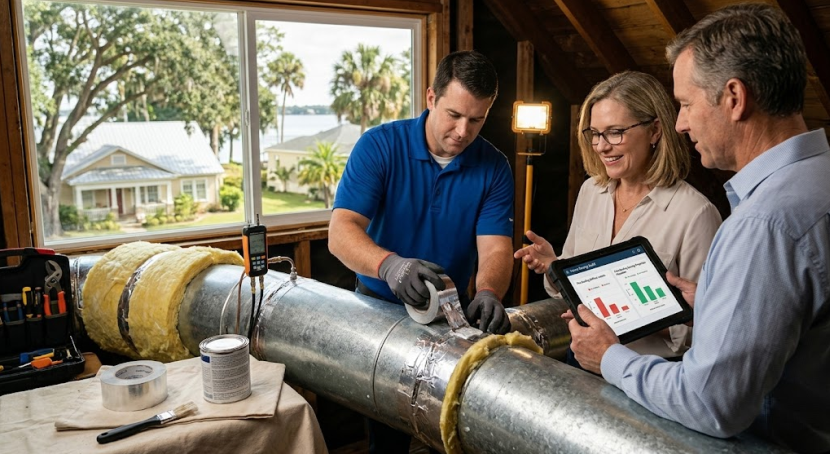
"Nine times out of ten, when a Sanford homeowner tells us their AC can't keep up with the heat, the unit isn't the problem — it's the ductwork bleeding cooled air into the attic before it ever reaches the living space. Once we seal those leaks, they're usually surprised at how much capacity their existing system actually had all along."
7 Essential Resources Every Sanford Homeowner Needs Before Sealing Air Ducts
We tell every Sanford family the same thing before they schedule a duct sealing appointment — and yes, this includes families who call us: do your homework first. Living and working in Central Florida ourselves, we know how many HVAC decisions get rushed when the house won't cool down in July. These are the government and industry resources we trust and refer our own neighbors to, so you can walk into any conversation with a contractor — including ours — fully informed and confident.
1. Understand How Duct Sealing Works and Why It Matters
ENERGY STAR — Duct Sealing Guide This is the resource we point Sanford homeowners to first. The EPA's ENERGY STAR program explains what duct sealing actually involves, which materials work (and which don't), and where leaks typically hide. It's also where the 20–30% energy loss figure we reference comes from — a number our technicians validate on Central Florida service calls regularly.
URL: https://www.energystar.gov/saveathome/heating-cooling/duct-sealing
2. Learn the Technical Side of Duct System Efficiency
U.S. Department of Energy — Minimizing Energy Losses in Ducts If you want to understand why your ducts leak and how the system is supposed to function, this DOE resource breaks it down in plain language. We've found that homeowners who read this before their service appointment ask better questions and feel more confident about the work being done in their home — which is exactly what we want.
URL: https://www.energy.gov/energysaver/minimizing-energy-losses-ducts
3. Verify Your Contractor's Work Meets Federal Standards
U.S. Department of Energy — Building America Duct Sealing & Insulation Checklist In our years serving Sanford-area families, we've seen duct sealing jobs from other companies that looked fine from the outside but failed basic quality standards. The DOE's Building America checklist gives you a professional-grade reference point to hold any contractor accountable — including us. Print it out before your appointment and don't be afraid to ask questions.
URL: https://basc.pnnl.gov/home-improvement-expert/checklists/duct-sealing-and-insulation
4. Know the Health Risks of Leaky Ductwork in Your Home
U.S. EPA — Introduction to Indoor Air Quality This one hits close to home for Central Florida families. Leaky return ducts don't just waste energy — they pull in attic dust, mold spores, and humid unconditioned air that your family ends up breathing. The EPA's indoor air quality resource explains exactly how that happens and why it matters. We've had Sanford customers tell us their allergy symptoms improved within days of getting their ducts sealed, and this resource helps explain the science behind that experience.
URL: https://www.epa.gov/indoor-air-quality-iaq/introduction-indoor-air-quality
5. Find a Nationally Recognized HVAC Contractor Near Sanford
ACCA — Contractor Locator Tool The Air Conditioning Contractors of America writes the national standards that quality HVAC companies follow. Their zip code search tool connects you with contractors who meet those standards. We always encourage our neighbors to compare — a good contractor welcomes that, because they know their work speaks for itself.
URL: https://hvac-contractors.acca.org/acca-at-home
6. Check Florida-Specific Rebates and Utility Incentives
My Florida Home Energy — Incentives for Florida Homeowners Before you schedule any duct sealing work, check what your utility company offers. This state resource from the Florida Department of Agriculture and Consumer Services outlines rebates for professional duct sealing along with energy efficiency loans that can reduce your out-of-pocket cost. Sanford homeowners on Duke Energy should look here first — we've helped families navigate these programs and they can make a real difference in overall project cost.
URL: https://www.myfloridahomeenergy.com/help/library/financing-incentives/incentives/
7. Claim Federal Tax Credits for Qualifying Duct Sealing Work
IRS — Energy Efficient Home Improvement Credit (Form 5695) The federal government offered a 30% tax credit on qualifying insulation and air sealing materials, up to $1,200, for work completed by December 31, 2025. That credit has since expired for new projects, but if you had duct sealing done in 2025, you may still be eligible when you file your return. We always recommend our customers consult the IRS resource directly and talk to their tax preparer to confirm eligibility — every dollar back in your pocket matters.
URL: https://www.irs.gov/credits-deductions/energy-efficient-home-improvement-credit
What the Numbers Say — And What We See in Sanford Attics Every Week
Statistics tell part of the story. What our technicians find during service calls across Sanford and Seminole County tells the rest.
1. Most Sanford Homes Are Cooling Their Attics Without Knowing It
The EPA's ENERGY STAR program puts average duct leakage at 20–30% of conditioned air lost before it reaches your living space. After testing duct systems in hundreds of Sanford-area homes, we can tell you that number is conservative for this market.
Here's why Central Florida homes trend toward the high end of that range:
Attics routinely hit 140°F in summer
Flex duct connections installed in the 1990s and early 2000s weren't built to withstand decades of that heat
Mastic dries out, tape fails, and boot connections shift over time
By the time a homeowner notices one bedroom won't cool down, the air has been bleeding into the attic for years
Most families don't have a reason to look until the comfort problem becomes impossible to ignore. That's when they call us — and that's when the duct leakage test tells the real story.
Source: U.S. Environmental Protection Agency — ENERGY STAR Duct Sealing https://www.energystar.gov/saveathome/heating-cooling/duct-sealing
2. The Real Reason Your AC "Can't Keep Up" Usually Isn't the AC
This is the statistic we wish we could put on a billboard in Sanford.
University of Florida IFAS Extension research found that ducts leaking just 20% of conditioned air force the HVAC system to work 50% harder. Not 20% harder. Fifty.
We see the same pattern constantly:
A family calls because their system runs all day and the house never feels right
Another company quotes $8,000–$12,000 for a full replacement
We pressurize the duct system and find leaks at every major junction in the attic
A $1,500 duct sealing job later, the same "failing" system cycles normally and holds temperature in every room
The equipment was never the problem. It was fighting a battle it couldn't win with half its air supply escaping through gaps nobody had checked in fifteen years.
Source: University of Florida IFAS Extension — Energy Efficient Homes: The Duct System https://edis.ifas.ufl.edu/publication/FY1024
3. Your Family Spends 90% of Their Time Breathing Whatever Your Ducts Deliver
According to the EPA, Americans spend approximately 90% of their time indoors. Indoor pollutant concentrations can run 2 to 5 times higher than outdoor levels.
In Sanford, where we keep our homes sealed against heat and humidity eight or nine months of the year, that exposure window matters even more.
Here's what leaky ducts mean in practical terms for your family's air:
Every system cycle pulls unfiltered attic air through return-side leaks
That air carries insulation fibers, dust, mold spores, and moisture
It gets pushed directly into the rooms where your family sleeps, eats, and spends their evenings
Our technicians have pulled back duct connections in Sanford attics and found visible mold growth right at the leak point — where humid outside air meets the cooler duct surface. The homeowners had been dealing with unexplained allergy symptoms for months. Within a week of sealing those ducts, two family members reported breathing easier for the first time since moving in.
We hear versions of that story more often than you'd expect.
Source: U.S. Environmental Protection Agency — Indoor Air Quality Report on the Environment https://www.epa.gov/report-environment/indoor-air-quality
Final Thought: The Smartest HVAC Investment Most Sanford Homeowners Never Consider
After years of servicing homes across Sanford and Seminole County, we'll say it plainly: air duct sealing is the single most undervalued home improvement in Central Florida.
It's not glamorous. Nobody posts about it on social media. No neighbor walks over to admire your freshly sealed ductwork. But dollar for dollar, no other home investment delivers this combination:
Immediate comfort improvement
Measurable energy savings
Better indoor air quality
Extended equipment life
All in a single service visit
What Frustrates Us Most in This Industry
Every week, we meet Sanford families who've already spent thousands replacing an AC system that was never the problem. They were sold equipment when what they actually needed was someone to climb into the attic, pressurize the ducts, and seal the leaks, stealing 25–30% of their conditioned air.
That's not a technology problem. That's a diagnosis problem. And it's one we take personally.
Our Honest Advice to Sanford Homeowners
1. Get a duct leakage test before you replace any equipment. If your system runs constantly and your home won't hold temperature, leaky ducts are the most likely cause — and the least expensive fix. A $1,500 duct sealing job should always come before a $10,000 system replacement conversation.
2. Don't wait for a comfort crisis to check your ductwork. The leaks that cost you the most are the ones you don't notice for years. If your home was built before 2005 and you've never had your ducts tested, schedule it now — not next summer when every HVAC company in Seminole County is booked out three weeks.
3. Treat duct sealing as a health decision, not just an energy decision. Your family breathes whatever your duct system delivers. In a climate where homes stay closed up most of the year, leaky return ducts pulling attic contaminants into your living space isn't just an efficiency issue. It's a quality of life issue.
4. Use the resources in this guide to hold any contractor accountable. We included seven government and industry resources above for a reason. Print the DOE checklist. Verify credentials through ACCA. Check your utility rebate eligibility. A contractor who does quality work welcomes an informed homeowner. If the company you're talking to gets uncomfortable when you ask detailed questions, that tells you everything you need to know.
The Bottom Line
We're biased — we do this work every day. But the statistics from ENERGY STAR, the University of Florida, and the EPA aren't our numbers. They're federal and state research confirming what we observe on every service call:
Most homes are losing significant conditioned air through ductwork that nobody has inspected, tested, or sealed since the day it was installed.
The air your family breathes and the money you spend keeping your home comfortable both flow through the same system. When that system leaks, you lose on both counts.
Sealing it is the smartest move a Sanford homeowner can make — and it's the one most people don't know to ask about until they've already spent money in the wrong places.
That's what we're here to change.
FAQ on Air Duct Sealing in Sanford
Q: How much does air duct sealing cost in Sanford?
A: Most Sanford homeowners pay between $800 and $2,500. Where you land depends on three factors:
System size and total linear feet of ductwork
Attic accessibility and working conditions
Severity of existing leaks and connection deterioration
Homes in Sanford's older subdivisions — particularly those built in the late 1980s through early 2000s — tend to need more extensive work. Original flex duct installations used minimal sealant at connection points, and decades of attic heat have broken down what little was applied.
The payback is fast. Most families we work with recover the investment within one to two cooling seasons through lower energy bills alone. We always run a duct leakage test before quoting any work so you see the actual numbers first.
Q: How do I know if my air ducts need sealing in Sanford?
A: The house will tell you. These are the five symptoms our technicians hear about most from Sanford families:
Rooms that never reach the same temperature as the rest of the house
Energy bills that creep higher each year with no change in habits
Dust that comes back within a day or two of cleaning
Indoor air that feels humid or sticky even with the AC running
A system that cycles nonstop during summer afternoons
Any one symptom can have other explanations. Two or three together almost always point to duct leakage.
The only way to confirm it is a pressure test. If your home was built before 2005 and nobody has ever tested your ducts, we'd bet the leaks are there. We just haven't found them yet.
Q: Is air duct sealing worth it in Florida's climate?
A: In most of the country, duct sealing is smart. In Central Florida, it's borderline essential.
Here's the reality our technicians deal with daily:
Sanford attics hit 140°F by mid-morning in July
Every gap bleeds cooled air directly into that heat
Return-side leaks simultaneously pull superheated, humid attic air back into your living space
Your AC doesn't stand a chance against that combination
University of Florida research confirms it. Just 20% duct leakage forces the system to work 50% harder. In this climate, that means hundreds of extra dollars per year in cooling costs and years shaved off your equipment's lifespan.
After sealing ducts in Sanford homes for years, we can say with confidence: no other single service delivers the same combination of lower bills, better comfort, improved air quality, and reduced equipment strain. We've never had a customer tell us they wished they hadn't done it.
Q: How long does air duct sealing last?
A: Professional-grade duct sealing using mastic sealant and metal-backed tape holds for 10 to 15 years or longer. The emphasis is on professional-grade.
What we find in Sanford attics tells the story:
Three or four layers of standard duct tape from previous repair attempts — all peeled back and failing
Regular duct tape dries out and loses adhesion within one to two years in Florida attic temperatures
It was never engineered for the thermal cycling our ductwork endures
Mastic is different. It cures into a flexible, permanent seal that moves with the duct as it expands and contracts. That's why it's the only material our technicians use on every joint and connection.
We still recommend a visual inspection every few years during routine maintenance. Not because the sealant fails — but because new leaks can develop at other points as the system ages. Catching them early keeps you ahead of the problem.
Q: Should I seal my ducts before replacing my AC system in Sanford?
A: Every single time. No exceptions. This is the hill we'll die on.
Here's why:
A new AC system on top of leaky ducts will underperform from day one
You pay for maximum efficiency but the delivery system sabotages it
We've walked into Sanford homes where homeowners spent $10,000+ on new equipment six months earlier — same hot spots, same high bills
The reason was always the same: nobody tested the ducts before selling them a new unit
Our recommendation is simple:
Seal first. Address the duct leaks before making any equipment decisions.
Then evaluate. In most cases, the existing system performs as designed once the ducts stop hemorrhaging air.
Replace only if still needed. If you do need new equipment after sealing, you'll get full benefit of the efficiency rating because the air actually reaches your rooms.
Either way, you come out ahead. That's not a sales pitch. That's what the math shows on every job we complete.
Now You Know Why Smart Sanford Homeowners Invest in Air Duct Sealing — Take the Next Step
Find out exactly where your conditioned air is going with a professional duct leakage test from our Sanford-area technicians. Schedule your assessment today and stop paying to cool your attic.
Here is the nearest branch location serving the Palmetto Bay FL area…
Filterbuy HVAC Solutions - Miami FL
1300 S Miami Ave Unit 4806, Miami, FL 33130
(305) 306-5027